
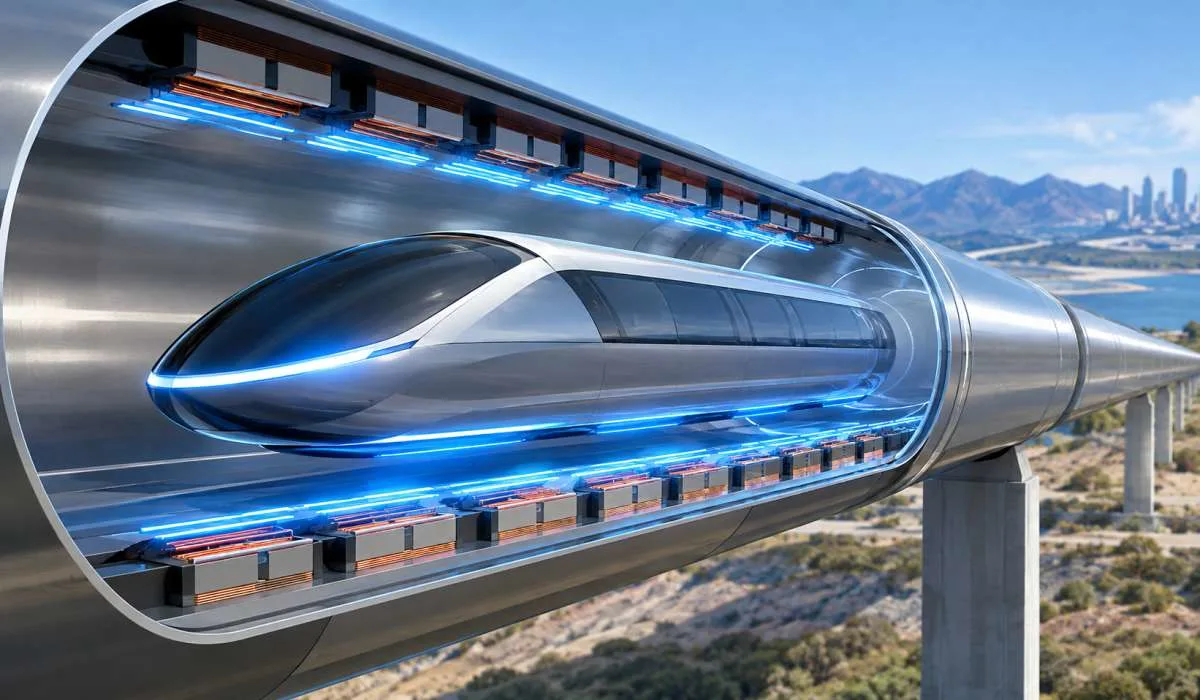
The Hyperloop tube design explained here is not just about a pipe. It is about engineering. The tube must hold a near-vacuum while supporting its own weight. It must resist crushing pressure from the outside. It must handle temperature changes and ground movement.
It must also give the pod a smooth path to float and travel. Every detail matters. The steel sections the expansion joints. The vacuum pumps. The magnetic track inside without careful design, the pod cannot reach the speeds that make Hyperloop revolutionary. This guide breaks down how the tube works and why each element exists.
What Is Hyperloop?
Hyperloop is a proposed high-speed transportation system. It uses capsules, called pods, that travel through low-pressure tubes . The concept was popularized by Elon Musk in 2013 . The idea is simple. Remove most of the air from a tube. Then float a pod inside it and push it forward with magnets. With almost no air resistance and no track friction, the pod can reach speeds of up to 1,200 km/h .
Think of it as a maglev train inside a vacuum tube . The tube protects the pod from weather and eliminates most drag. The pod floats on magnets, so it never touches the ground. The result is a system that could move people as fast as a plane but with far less energy .
Read More: Hyperloop Latest News 2026: New Speed Records and Projects
The Tube Structure
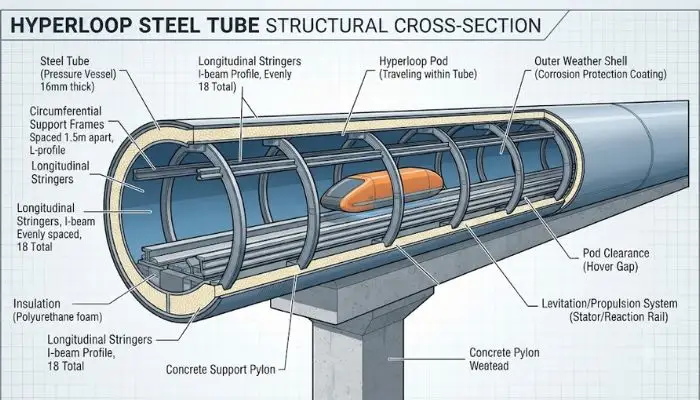
The tube is the most visible part of Hyperloop. It looks like a long, sealed pipe. But its design is complex.
Material and Construction
The tube is typically made from steel. Thin-walled steel sections are joined together to form a continuous tube . These sections are produced from hot-rolled steel strip. The strip is formed into shape and welded closed.
The tube has a skeletal frame. Longitudinal stringers run along the length. Circumferential sections wrap around the tube at intervals. The thin outer skin attaches to this frame . This design gives strength without too much weight.
Shape Options
The cross-section of the tube is usually circular. But oval and elliptic shapes are possible. These are useful at switches, where two tubes merge into one . Polygonal shapes with eight or more sides are also an option for practical reasons.
Buckling Resistance
The inside of the tube is a vacuum. The outside is normal atmospheric pressure. This pressure difference wants to crush the tube. The design must resist buckling .
The spacing between circumferential sections matters. The distance is smallest in the middle of each tube section. It is largest at the ends. This optimises buckling resistance. The number of longitudinal stringers is often a prime number. This avoids repeating patterns that could weaken the structure .
Thermal Expansion and Movement
The tube expands and contracts with temperature changes. It also shifts with ground movement. Expansion joints allow the tube to change length without cracking . The tube is often elevated on columns. This makes it easier to realign if the ground shifts .
Creating the Vacuum
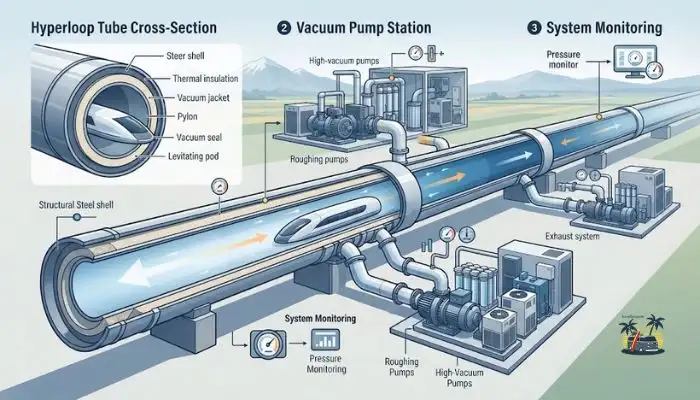
The tube must be depressurised to reduce air resistance. The pressure inside is less than 0.1 bar. In preferred designs, it drops below 0.01 bar, or even to 5 millibars or 2 millibars . That is close to the vacuum of space.
How the Vacuum Is Maintained?
Vacuum pumps remove air from the tube. They keep the pressure low during operation. The pod itself can help. Some designs include systems on the pod that sweep gas particles out of the way .
The tube has multiple layers in some designs. An outer tube and an inner tube create an annular space between them. This allows different pressure levels. The inner tube holds the vacuum for the pod .
How the Pod Travels?
The pod does not touch the tube. It floats. This eliminates friction from rolling.
Magnetic Levitation
- Most Hyperloop designs use magnetic levitation. Magnets on the pod interact with conductive materials in the tube. This creates a repulsive force that lifts the pod . The pod floats a small distance above the track.
- Two main levitation methods exist. Electromagnetic suspension uses attractive forces. Electrodynamic suspension uses repulsive forces. Halbach arrays are also used to shape magnetic fields for better performance .
Propulsion
- Linear electric motors push the pod forward. These motors are embedded in the tube or the track. They create a moving magnetic field that pulls the pod along .
- The pod accelerates at about 0.5G. That is similar to an aircraft during takeoff. It takes roughly 50 kilometres to reach top speed and another 50 kilometres to stop .
Advantages of Hyperloop
Hyperloop offers several benefits over other transport modes.
Energy Efficiency
Removing air from the tube dramatically reduces drag. A study found that at 1,260 km/h, drag force dropped by a factor of 371 compared to normal conditions. Power consumption fell from 35,661 kW to just 96 kW . This makes Hyperloop far more energy-efficient than high-speed rail or air travel.
Environmental Benefits
Hyperloop can be powered by renewable energy. Solar panels on top of the tube can generate electricity . The system produces almost no noise and no direct emissions . It also uses less land than highways or railways. The tube requires a strip only 8 metres wide .
Speed and Convenience
Hyperloop could cut journey times dramatically. A trip from Los Angeles to San Francisco would take about 35 minutes instead of hours . It offers the speed of a plane with the convenience of a train .
Weather Independence
The tube protects the pod from rain, snow, and wind. Hyperloop can operate regardless of weather conditions .
You May Also Read: How Does Hyperloop Transportation System Work?
Challenges and Current Progress
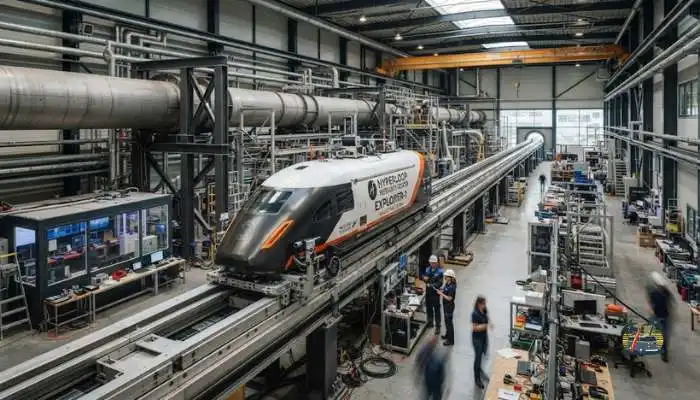
Hyperloop is still in development. No full-scale system carries passengers yet.
Technical Challenges
The tube must maintain a vacuum over long distances. Pumps and seals must be reliable. Ground movement and thermal expansion require careful engineering . The pod must accelerate and decelerate smoothly without causing discomfort. Curves must be very gentle because of the high speeds .
Cost
Building a Hyperloop network is expensive. Estimates for the original Los Angeles to San Francisco route were around $6 billion . However, some studies suggest operating costs could be lower than high-speed rail. The energy savings and low maintenance needs help with return on investment .
Recent Tests
In 2024, EPFL and Swisspod completed the longest Hyperloop trial in Europe. They achieved a full-scale equivalent journey of 141.6 km with top speeds of 488.2 km/h . In 2025, Hardt Hyperloop set a new record at the European Hyperloop Center. Its capsule reached 85 km/h and performed a lane switch for the first time .
FAQs
1. How does Hyperloop work?
Hyperloop uses pods that travel through low-pressure tubes. Magnetic levitation lifts the pod off the track. Linear motors push it forward. The vacuum inside the tube removes most air resistance, allowing very high speeds .
2. What is the Hyperloop tube made of?
The tube is typically made from steel. Thin-walled sections are joined together. A skeletal frame with longitudinal stringers and circumferential sections provides strength and buckling resistance .
3. Why is the tube a vacuum?
Air resistance increases with speed. At 1,200 km/h, normal air would create enormous drag. Removing the air allows the pod to travel much faster with far less energy .
4. What is Hyperloop speed?
Proposed top speeds are around 1,200 km/h. That is close to the speed of sound. A test in 2024 achieved a full-scale equivalent of 488.2 km/h . Speeds of 700 km/h are considered feasible .
5. What are the advantages of Hyperloop?
It is energy-efficient, fast, and environmentally friendly. It uses less land than roads or railways. It operates in any weather. It could cut journey times dramatically .
6. What is the meaning of Hyperloop?
The word combines "hyper" and "loop." It describes a looped tube transport system that moves pods at very high speeds. The name was coined for Elon Musk's 2013 concept .
7. How does the pod float in the tube?
Magnets create a repulsive or attractive force that lifts the pod. This is called magnetic levitation. It eliminates friction from wheels touching a track .
8. Is Hyperloop safe?
The concept includes safety features like emergency braking and pressure locks. The pod operates in a controlled environment. But no passenger system has been built yet, so real-world safety is still being studied .
