
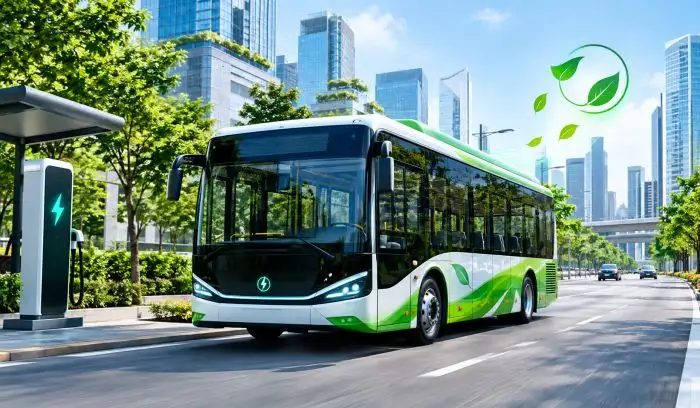
Electric buses are everywhere now. Quiet, Clean, no diesel smell. You see them in London, Delhi, Shenzhen, and dozens of other cities. But most people have no idea how they actually move. The short answer: how electric buses work is simple.
A battery holds power. A motor turns the wheels. You plug in to refill. That is it. No engine. No gears. No exhaust. Some charge overnight at the depot. Others top up in minutes at bus stops. The details matter though. Battery size, charging speed, route length. This guide walks you through all of it. Plain words. Real examples. Let us start.
The Basic Parts of an Electric Bus
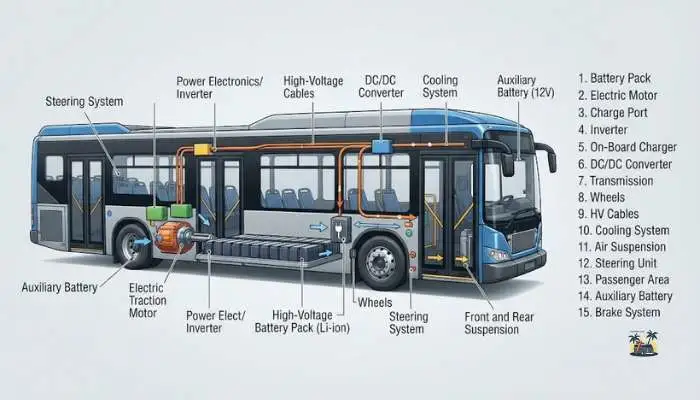
An electric bus has four main parts that make it move :
- Battery – Stores energy. This is the heart of the bus. Batteries range from 50 kWh on small fast-charge models to over 700 kWh on long-range coaches .
- Motor – Uses power from the battery to turn the wheels. Electric motors are quiet and deliver full power instantly.
- Charge Port – Where you plug in to refill the battery. Some buses have overhead connections instead of plugs.
- Controller – The brain that manages power flow from battery to motor.
Read More: Bus Travel Guide: Best Seats, Rules, Booking and Comfort Tips
How Electric Buses Work Step by Step?
Here is the simple version :
- You plug in the bus. The charger sends electricity to the battery through the charge port.
- The battery stores energy. Think of it like a giant phone battery.
- You unplug and drive. The controller sends power from the battery to the motor.
- The motor turns the wheels. No gears. No combustion. Just smooth electric power.
- When the battery runs low, you charge again.
The EPA explains it for kids this way: an electric school bus looks the same as a regular bus, but it uses batteries instead of diesel. The charger provides power. The charge port connects the bus to the power source. The battery stores energy. The motor uses that power to move the wheels .
What Is a Bus in an Electrical Power System?
The word "bus" has two completely different meanings. This confuses people all the time.
- In an electric bus (the vehicle), a bus is a large vehicle that carries passengers. It runs on batteries and an electric motor.
- In an electrical power system, a "bus" is something else entirely. It is a connection point in a power grid. Think of it like a junction box where power lines meet. Power system engineers use "buses" to model how electricity flows through a network . A "slack bus" is a reference point in power flow studies. A "load bus" is where power is consumed .
These two uses of the word have nothing to do with each other. Same word. Different worlds.
How Do Electric Buses Charge?
Electric buses use different charging methods depending on their routes and schedules .
Depot Charging (Overnight)
Most transit buses charge at the depot overnight. They park, plug in, and refill while the grid has extra capacity. This is the cheapest way to charge. Slow charging takes up to 10 hours. Faster depot charging takes 2 to 5 hours .
Opportunity Charging (During the Day)
Some buses charge during short breaks at bus stops or terminals. This is called opportunity charging. A conductive fast charging system can add power in just 2 to 7 minutes . The bus pulls up. An automated arm connects. Power flows. The bus keeps moving. This lets buses run all day without a long overnight charge.
Overhead Pantograph Charging
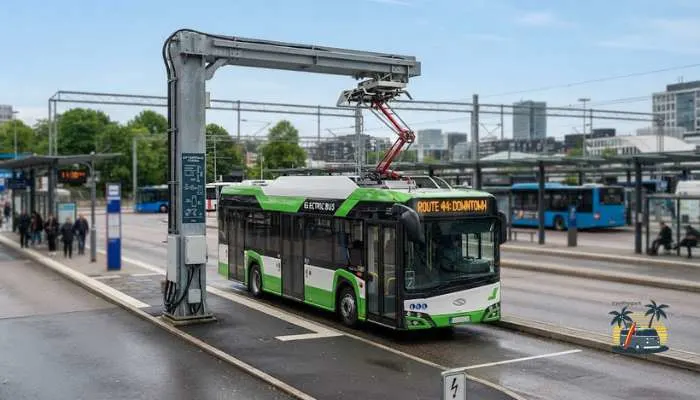
Instead of plugging in a cable, some buses connect to an overhead charger. A pantograph on the bus roof rises to touch a power rail. Charging happens in 5 to 20 minutes at high power . This keeps the bus on schedule with minimal downtime.
Wireless Inductive Charging
Some systems use floor-mounted pads. The bus parks over the pad. A magnetic field transfers power through the air. No cables. No arms. Just park and charge .
How Electric Buses Work for Kids?
Here is the simple explanation for young learners :
- An electric bus is like a giant toy car that runs on batteries. You plug it in to charge, just like you charge a tablet. Then it drives around without making any smoke. No loud engine noise. Just a quiet hum. When the battery gets low, the driver takes it back to the depot and plugs it in again.
- Electric buses are better for the air we breathe. Diesel buses release exhaust that can make people sick. Electric buses have zero tailpipe emissions. That means cleaner air for everyone .
Electric Bus Manufacturers
Several companies build electric buses. Some names you will see :
- BYD – One of the biggest electric bus makers. Their new B18.b articulated bus carries up to 146 passengers and goes 630 km on a charge .
- Volvo – Builds the BZR Electric coach chassis with up to 720 kWh of battery capacity .
- Wrightbus – Makes the Electroliner. The double-deck version goes 275 miles and charges in 1¼ hours at 380 kW .
- Yutong – A major Chinese manufacturer with a large global presence .
- New Flyer – A North American bus maker with electric models .
- JSW Group – Launched the Ampstar brand in India in 2026. Their plant in Maharashtra will build 15,000 electric buses and trucks per year .
Other manufacturers include Solaris, MAN, Iveco Bus, VDL, and Ebusco .
You May Also Read: Best Bus Booking Apps for Cheap Tickets and Government Bus Booking
The Bottom Line
Electric buses work by storing electricity in large batteries and using that power to turn an electric motor. They charge at depots overnight or during quick stops along their routes. The technology is proven. Cities around the world are switching from diesel to electric.
The benefits are clear: no tailpipe emissions, quieter streets, and lower fuel costs. The challenges are charging infrastructure and upfront price. But as battery costs fall and charging networks grow, electric buses are becoming the standard for public transit.
If you see a bus that is quiet and has no exhaust, it is probably electric. That is the future of city transport. And it is already here.
FAQs
1. How does an electric bus actually move?
A battery stores power. A controller sends that power to an electric motor. The motor turns the wheels. No diesel. No engine. No gears. Just electricity doing the work. You plug in to refill the battery. Then you drive.
2. How far can an electric bus go on one charge?
Depends on the battery. Small city buses go 100 miles or more. Bigger models go further. Volvo's BZR coach hits 435 miles. BYD's B12.b bus goes 650 kilometers. Newer batteries keep pushing that number up every year.
3. How do electric buses charge?
Most charge at the depot overnight. Plug in when the day ends. Refill while the grid is quiet. Some buses charge during the day at bus stops. A fast charger adds power in 2 to 7 minutes. Enough to finish the route. Some use overhead arms that touch a power rail. No cables needed.
4. What does "bus" mean in an electrical power system?
Different thing entirely. In a power grid, a "bus" is a connection point. A junction where power lines meet. Engineers use it to model how electricity flows. A "slack bus" is a reference point. A "load bus" is where power gets used. Same word. Two completely different meanings.
5. Who makes electric buses?
BYD is one of the biggest. Volvo builds the BZR coach. Wrightbus makes the Electroliner. Yutong is huge in China. New Flyer covers North America. In India, JSW Group launched Ampstar in 2026. Their plant will build 15,000 electric buses and trucks a year.
