

A Hyperloop pod travels through a tube with almost no air. That sounds simple. But the little air that remains causes big problems. At near-sonic speeds, the pod pushes that thin air ahead of it. The air cannot escape fast enough. It compresses. It forms shockwaves. It creates drag. The pod's shape decides how bad this gets. The nose matters. The tail matters more.
Learning about hyperloop pod aerodynamics explained simply comes down to one thing. The gap between the pod and the tube is tiny. That small space changes everything. This guide breaks it down in plain terms. No equations. No jargon. Just what happens when a pod moves fast through a tube.
The Core Problem: Blockage Ratio
The tube is not much wider than the pod. The gap between them is small. Engineers call this the blockage ratio. It is the pod's cross-sectional area divided by the tube's area .
A high blockage ratio means the air has less room to flow past the pod. It gets squeezed. It speeds up. It behaves like water in a narrow pipe. This is why Hyperloop aerodynamics is different from an aircraft in open sky. A plane has unlimited air to push aside. A pod does not.
Studies show that drag increases with pod speed, blockage ratio, and tube pressure . The tighter the fit, the harder the air fights back.
Read More: Hyperloop Tube Design Explained: Inside the Technology Behind Superfast Travel
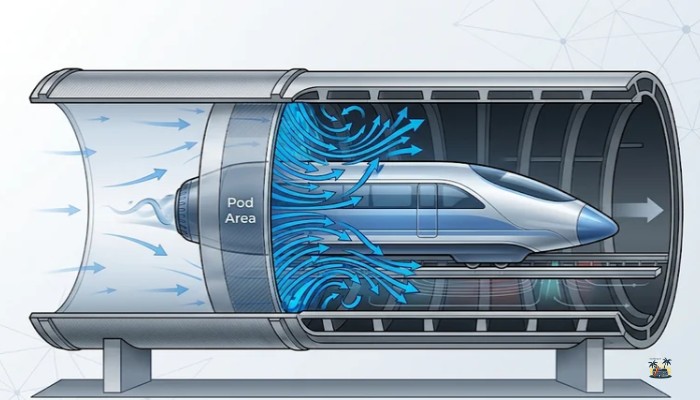
What Happens at Speed: The Three Regimes?
Researchers divide pod speeds into three regimes .
Regime 1: Below the Critical Mach Number
At lower speeds (around 100 to 150 m/s), the flow is relatively calm. The air moves past the pod without major disruption. Aerodynamic forces are manageable.
Regime 2: Transition
Around 200 m/s, the flow starts to accelerate in the gap between the pod and the tube wall. The air is moving faster than the pod itself. Things get complicated.
Regime 3: Fully Accelerated Flow
Above 250 m/s, the flow in the gap reaches supersonic speed. A strong oblique shockwave forms. This is where aerodynamics becomes critical. The shockwave changes everything. Lift can flip from positive to negative. Drag behaves unpredictably .
The Nose and Tail: What Matters Most
You might think the nose is the most important part. It is not.
The Nose Does Little
Research found that the nose shape has a small effect on drag. An upward nose produces positive lift. A downward nose produces negative lift. But the nose only accounts for less than 10% of the total lift on the pod . Its shape is not the main issue.
The Tail Is Critical
The tail is where the action is. In Regime 3, a downward tail produces positive lift. An upward tail produces negative lift. The lift-to-drag ratio becomes negative for an upward tail at high speed .
The conclusion from the research is clear. Upward tails should be avoided. A downward tail is better for efficiency. The tail shape strongly affects lift, and lift affects how the pod behaves on its magnetic suspension .
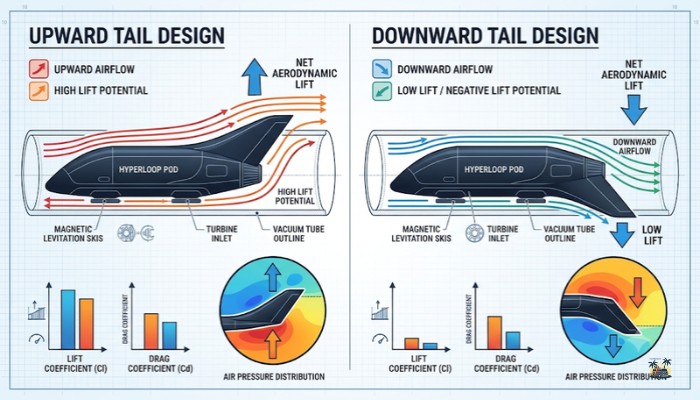
Why Lift Matters?
The pod floats on magnets. It does not have wheels. But aerodynamic lift still matters. Positive lift can help the magnetic system. Negative lift pushes the pod down. It fights the magnets. It creates instability.
The total lift is mostly generated by the tail. The nose contributes very little. This means the tail design is not just about drag. It is about keeping the pod stable and efficient at speed .
The Shockwave Problem
At high speed, a shockwave forms in front of the pod. The air cannot get out of the way fast enough. It piles up. It compresses into a sharp pressure change.
The presence of magnetic levitation supports makes this worse. One study found that maglev supports intensified the leading shockwave by 4.3% . The supports create disturbances in the flow. They increase drag. They add to the pressure changes.
A flat tail design helped reduce these effects. It generated positive lift consistently. The streamlined tail kept the shockwave structure more stable .
You May Also Read: Hyperloop Latest News 2026: New Speed Records and Projects
Beyond Subsonic: The Future
Some researchers are looking at supersonic pods. That means traveling faster than the speed of sound inside the tube. This introduces new problems. Flow choking is one. The air in the gap can reach a point where it cannot move any faster. It blocks the flow .
Solutions involve staged tubes. The tube changes shape along the route. It helps guide the air from atmospheric pressure down to near-vacuum. Computer models show this can reduce drag significantly. But it is still at the concept stage. The engineering challenges are enormous .
FAQs
1. What is Hyperloop pod aerodynamics?
It is the study of how air flows around a pod inside a low-pressure tube. The main concerns are drag, lift, and shockwaves. The tight space between the pod and the tube makes the airflow complex.
2. How does Hyperloop work?
A pod travels through a tube with most of the air removed. Magnets lift it off the track. Linear motors push it forward. The low pressure reduces air resistance, allowing very high speeds .
3. What is the Hyperloop speed?
The concept targets speeds around 1,200 km/h. Test runs have reached lower speeds. Swisspod achieved a full-scale equivalent of 488.2 km/h in a scaled test . Hardt Hyperloop reached 85 km/h on a short track and aims for 700 km/h when infrastructure allows .
4. Why is the tail shape important?
Because it generates most of the lift. An upward tail produces negative lift at high speed. That fights the magnetic suspension. A downward tail produces positive lift and is more efficient .
5. What is the blockage ratio?
It is the pod's cross-sectional area divided by the tube's area. A high ratio means the air has less room to flow past. This increases drag and makes shockwaves more severe .
6. What is a shockwave in Hyperloop?
It is a sharp pressure change that forms when the pod moves faster than the air can move out of the way. The air compresses in front of the pod. This creates drag and can affect stability .
7. What is the Hyperloop meaning?
The name combines "hyper" and "loop." It describes a looped tube transport system that moves pods at very high speeds. It was popularized by Elon Musk in 2013 .
8. Is there a Hyperloop technology PDF I can read?
Research papers on Hyperloop aerodynamics are available through academic journals like ScienceDirect and arXiv. Search for terms like "Hyperloop pod aerodynamics" or "evacuated tube transport" to find them.
